you can turn music on if you like ...

"handwriting problems" page - "FORTUNE MY FOE" on electronic instruments (Kate's MIDI sequencing of an anonymous Renaissance piece FORTUNE MY FOE: the folk-tune, not the well-known John Dowling work which it inspired)

illegibility: can America write?

some facts on our handwriting crisis


The AMA's 1994 summer conference revealed that unreadable Rx's and medical records
present a major health hazard. Statistics established that
at least 1 in 10 Americans'
health suffers because of physicians' handwriting.

See also the later research by Charles Inlander in his book MEDICINE ON TRIAL;
pharmacists have difficulty reading 93% of the prescriptions they receive.
Even in hospitals,
20% of prescriptions defeat all attempts to read them
.

Click here for "Deadly Handwriting" -- how a doctor's scrawl caused brain injury, then death, to a patient.

In Queens, New York, another doctor's illegible handwriting kept his patient on dangerously wrong medication for almost a year. Click here to learn how it happened.
How a sloppily handwritten dosage amount killed a baby ... on his way to going home from the hospital.

For more disturbing events and statistics relating to illegible medical penmanship, click here to jump to "physicians' handwriting: the facts" - further down on this page.


THE COSTS OF INCOMPETENT HANDWRITING
  1. Each year, unreadable tax-form addresses mean that up to $95,000,000 in tax refunds cannot reach the people who should receive them.

  2. A plane crashed in December 1992 ... because of poor handwriting. The pilot misunderstood the co-pilot's scribbled notes and instrument readings. Acting on this wrong information caused the crash and resulting deaths. (Source: the handwriting improvement guide PLEASE WRITE: HOW TO IMPROVE YOUR HANDWRITING FOR BUSINESS AND PLEASURE IN TEN QUICK AND EASY LESSONS by Wolf von Eckardt)

  3. Similarly, internal investigation of a 1965 NASA failure revealed the surprising cause: an engineer's scrawled (and misread) instructions. (Source: the handwriting improvement guide PLEASE WRITE: HOW TO IMPROVE YOUR HANDWRITING FOR BUSINESS AND PLEASURE IN TEN QUICK AND EASY LESSONS by Wolf von Eckardt)


  4. According to WIMA (the Writing Instrument Manufacturers Association) and other good-handwriting advocates, each year the United States loses over $200,000,000 for handwriting-related reasons. This far exceeds the severe economic loss that the FBI has traced to the thefts of computer hackers/crackers and other perpetrators of computer fraud.
    These
    $200,000,000 lost yearly because of problem handwriting include time and money lost because ...


ILLEGIBILITY WARPS THE NAMES OF PLACES:


HOME ON THE RANGE ... which range?

In Ashland, Wisconsin, bad handwriting changed the name of an iron-rich mountain range:
"Colonel Whittlesey, who was engaged in a geological survey of Northern Wisconsin [in the 1850s], had found much to encourage settlers to come to northern Wisconsin. The rich mineral wealth he found while surveying the Penokee range promised the need for railroads to be built. He had named the range 'Pewabic' (Indian word for iron) but his poor penmanship was misread as Penokee which is the name that has stayed with the range."


DOG-GONE HISTORY ... when an explorer's scrawl goes west

The illegible writing of explorer Meriwether Lewis left us guessing wrong - for almost two centuries - about the name of his dog.   -
" ... Did you know?    . For many years, scholars believed [explorer] Meriwether Lewis' Newfoundland dog was named Scannon. Blame bad penmanship. About 20 years ago[, in 1985], historian Donald Jackson noticed a Montana stream in an expedition map clearly designated as 'Seaman's Creek.' The explorers used names of expedition members for many geographic features, but,
'No person named Seaman is known to have been associated with the lives of either captain, and ... the word seems strangely nautical in view of its location,' Jackson wrote in his book 'Among the Sleeping Giants.'
'It occurred to me[, said Jackson,] that the name might be a garbled version of Scannon's Creek, in honor of the faithful dog. ... No geographical feature had yet been named for him during the entire expedition. I consulted microcopies of the journals held by the American Philosophical Society, half suspecting I would find that Seaman's Creek was actually Scannon's Creek. What I learned instead was mildly startling. The stream was named Seaman's Creek because the dog's name was Seaman.' ... "

Related info appears at
http://www.pbs.org/lewisandclark/inside/seaman.html
and
http://www.lewisandclarkphila.org/chapternews/chapterbooklist.html


FAKED ALASKA? No, mmm — just named that way

Blame illegibility, not mischievous gnomes, for the name of Nome, Alaska: the only American city named after an Arctic geographical feature named after ... nothing.
According to the Nome, Alaska history-site, " ... against its wishes the city was stuck with the unusual name of Nome. Unlike other towns which are named for explorers, hero[e]s or politicians, Nome was named as a result of ... error.
In the 1850's an officer on a British ship off the coast of Alaska noted on a manuscript map that a nearby prominent point was not identified. He wrote '? Name"' next to the point.
When the map was recopied, another draftsman thought that the ? was a C [which could stand for 'Cape'] and that the a in "Name" was an o, and thus a map-maker in the British Admiralty christened 'Cape Nome.' "


SEGUIN ... er, SEGUIM ... er, SEQUIM, WASHINGTON -- when good names go postal.

In 1879, pioneers in the northwestern United States named their settlement and its post office "Seguin" because the town lay on a prairie of the same name. By 1907, the U.S. Post Office had incorrectly registered the town's name -- twice -- thanks to poor handwriting on official reports in the days before keyboarding. According to city records, "In 1907, due to a Postal Official's error in reading an official report, the post office was titled 'Seguim' for approximately a month. With the next report, the Official read the letter 'g' as a 'q' and the post office here became known as 'Sequim.' The name change apparently did not worry the residents enough to protest. It has been known as Sequim ever since."


THE ILLEGIBLE VACATION DESTINATION

Travelers throughout the UK and around the world enjoy visiting Scotland and touring such scenic islands as the Hebrides ... but how many of them know that this famous name owes its current spelling and pronunciation to a long-ago handwriting error? The earliest records gave these islands the name of "Hebudae" or "Hebudes" -- when eighteenth-century tourists rediscovered the locale and researched island history, somebody mistook a handwritten "u" for a handwritten "ri" ... once enough other writers had copied the original error, it became official.


THE HIGHEST POINT IN THE SKY, THE LOWEST POINT IN CONFUSION

Even the sciences do not escape the terminological tumbles caused by scribbling scribes. The astronomical term "zenith" -- meaning the highest point in the sky, directly overhead -- started out as "samt": an Arabic word for "path" that early astronomers used in the phrase "samt arras" meaning the "path above the head." Medieval scribes, rendering Arabic words in Latin letters as they translated and copied, dutifully copied the unfamiliar word ... but, then as now, an "m" in handwritten copy often looked sloppy enough for the next person to read as "ni": eventually creating "zenith" as other errors and variations in usage accumulated.


AMERICA THE ILLEGIBLE:

HAIL (or something) TO THE CHIEF:
According to the LOS ANGELES TIMES on November 9, 2007, a National Archives audit of the Ronald Reagan Presidential Library revealed that the library had lost track of 80,000 of its 100,000 items — partly because of the sloppy handwriting of presidential aides and other staff who had selected, shipped, and catalogued the items.


ILLEGAL IMMIGRANT? ILLEGIBLE IMMIGRATION OFFICER!
Vermont Public Radio reports (October 31, 2007) on the illegibly scrawled visa waiver that turned a hopeful tourist into an illegal immigrant. Valeria Vinnikova, fiancée of Dartmouth College squash coach Hansi Wiens, had a visa waiver which authorized her to remain in the USA till October 13, 2007 — according to information provided to the soon-to-wed couple by a Homeland Security officer in the U.S. Customs and Borders Protection division. However ... the officer had misread the waiver's sloppily scrawled expiration date — actually October 3. The ten days' error (created by a couple of poorly written pen-strokes) caused Valeria to overstay her visa: requiring the US Government to initiate deportation proceedings which will bar Valeria from the country for ten years. As Vermont Public Radio notes: "Ten years of separation is not how Wiens and Vinnikova planned to start their marriage." UPDATE: Some concerned folks at Dartmouth College and elsewhere finally got this silly thing overturned — AFTER Valeria spent 28 days in three jails. Free at last, free at last ... until the next illegibly scribbling functionary comes along?


GIVING "THE UNKNOWN SOLDIER" A WHOLE NEW MEANING:
A U.S. Government investigation reported by NEWSDAY on November 10, 2007 revealed that a series of clerical errors (including the common handwriting error of confusing an "8" with a "3") left the wrong man buried in a hero's grave. The military cemetery tombstone erected for Willie Hayes (born 1948), an honorably discharged, triply decorated Vietnam war Army veteran, has turned out to mark instead the body of William Hayes (born 1943) who left the Army with a discharge other than honorable — and who died four years earlier than Willie. Because William did not in fact qualify for a military cemetery gravesite, the U.S. government has offered to pay for exhuming William's remains and burying Willie in his place. However, notes NEWSDAY, "since four years have elapsed since William Hayes was buried with military honors as Willie Hayes ... the body might be so decomposed that undertakers would have next to nothing to move."


SCOOTING "WRITE" AHEAD OF THE LAW
According to this CNN report, when I. Lewis "Scooter" Libby, former chief of staff to Vice-President Dick Cheney, had to appear before the grand jury in his trial for obstruction of justice and perjury, the court could not decipher Scooter's voluminous handwritten notes which formed a key part of the evidence in the trial. Therefore, Scooter received a rare privilege: permission to read these notes to the prosecutor. This allowed Scooter to claim that the notes said whatever Scooter wanted them to say. Although the court convicted Scooter, the president has commuted this conviction.

Outraged at handwriting corruption in high places?
Sign the
POLITICIAN LEGIBILITY ACT Petition!


ILLEGIBILITY AND YOUR FAVORITE FOODS:

GOOD GRAVY ... bad recipe card

Did you know that the "v" in the word "gravy" came from the bad handwriting of a medieval cook?
As Monash University linguistics professor Kate Burridge explains (in pages 69 - 71 of Burridge's WEEDS IN THE GARDEN OF WORDS: FURTHER OBSERVATIONS ON THE TANGLED HISTORY OF THE ENGLISH LANGUAGE)
" ... the word gravy ... derives from Old French, either graine meaning 'meat' or grané meaning 'grain of spice'.

... sometime during the 14th century, someone slipped up in translating the original French cook books and misread the 'n' of the French word — and the mistake stuck. ...
The problem was that the letters u, v, i, m, and n were all very similar at the time. The strokes were identical. To make matters worse, scribes didn't leave a space between the letters. So if you had a whole lot of them together it was extremely difficult to figure out what they represented. Let's say you had five strokes in a row. That could represent uni, uvi, imi, ivu, nui and a number of other possibilities. Things were made even harder because it wasn't the custom then to put a dot or a stroke above the letter 'i'. Small wonder there was the occasional slip."
Click here to see a medieval cookbook page with "n" often handwritten like "u" — and "u" often written like "n"
You'll find "graueye" — one way of spelling "gravy" back then — on the second line from the bottom. Note how much the "u" in "graueye" looks like the "n" in another word on the same cookbook page, "Codlyng" ["coddling"].

Confusing medieval letter-shapes like these led Renaissance scribes to search for an easier-to-read alphabet style that would still permit fast writing. Today, the quest for legibility continues among those who like their handwriting clearer than their gravy.


DELICIOUS, NUTRITIOUS, CHOCOLATEY, ... and misunderstood

Next time you stir up a glass of Ovaltine, think of this: the drink's inventor, Swiss scientist George Wander wanted to call it "Ovomaltine" because the original ingredients included egg protein and malt. However, his sloppy scrawl on the trademark application form left it officially named "Ovaltine" for many years.
(In Switzerland and many other nations, the product now has the name that Wander originally intended. But the USA and the UK still call it "Ovaltine.")


ILLEGIBILITY AND THE WORLD OF MUSIC:


DEDICATED TO THE ONE I DON'T CARE ABOUT —
HOW BEETHOVEN'S BAD HANDWRITING IMMORTALIZED THE WRONG GIRL

You have probably played or heard Beethoven's "Für Elise," the well-known piece he composed for the love of his life: Therese von Brunswick.
THERESE von Brunswick?! Yes.
When the manuscript turned up after Therese's death, Beethoven's semi-legible handwriting left the printer to guess about the title ... and the printer guessed wrong. Unfortunately for Beethoven and the rest of us, since Beethoven too had died he could not correct the error (which has remained in all editions).


DOING THAT SCRIBBLE THING —
HOW BAD HANDWRITING RE-NAMED AN ERIC CLAPTON CLASSIC

Bad handwriting has affected the rock world, too. Many Eric Clapton fans have puzzled over the name of Clapton's instrumental piece "Badge." Clapton wrote this piece as an instrumental bridge while working with the band CREAM. The band-leader, trying to decipher the scribbled score, mis-read Clapton's hand-scrawled "Bridge" as "Badge."


ILLEGIBILITY PUTS THE "GRINCH" ON YOUR SEASON'S GREETINGS

HOLIDAY HANDWRITING HAVOC: UK postal system destroys 5,000,000 illegibly addressed Christmas cards and letters
According to this United Press International news release, at the end of 2006 Britain's Royal Mail (the UK postal service) had to hire 3,000 new workers (more than twice its usual permanent staff of 1,400) just to decipher illegible addresses on holiday greetings.
Out of 2,000,000,000 cards and letters mailed in the UK during the Christmas season, each year the Royal Mail must destroy 5,000,000 as undeliverable because their addresses and return addresses defy decipherment.


ILLEGIBILITY CHANGES COMMON WORDS AND FAMOUS NAMES

NOTHING TO SNEEZE AT: When you have colds, flu, sinus problems, or allergies, say "Gesundheit!" for medieval mangled handwriting
Etymologists (students of word origins) have discovered that our word "sneeze" once began with an "f". Medieval English called a sneeze a "fnese" — which certainly sounds much more like sneezing than our version of the word. Partly because medieval handwritten "f"s and "s"s look very much alike, so many people perceived the "f" as an "s" that "sneeze" spread like a virus and "fnese" blew into extinction. (Source: Canadian Broadcasting Company program on word history)


SARAH JESSICA WHO? How a handwriting error changed the name of your favorite actress
When celebrity-watching journalist Abigail Pogrebin interviewed HBO's Sarah Jessica Parker, the actress revealed that her family owes its last name to a series of bureaucratic blunders which included one handwriting error. Pogrebin quotes Parker in ABC news coverage: "My great-grandfather on my father's side [was surnamed] 'Bar-Kahn' ... and the immigration officer thought he said 'Parken.' He wrote his N's like R's, so 'Parken' became 'Parker' ... ".


ILLEGIBILITY ALMOST "WROTE OFF" A HANDWRITING PROGRAM:

SCHOOL DAZE: when bad handwriting happens to good textbooks
Believe it or not, bad handwriting can prevent the teaching of good handwriting. When Portland State University Continuing Education Press produced the first edition of the Getty-Dubay Italic Handwriting Series, textbook authors Barbara Getty and Inga Dubay soon found that schools ordering the books weeks or months ago still had not received them. After many frantic calls to the warehouse, the ironic reason appeared.
A warehouse manager, trying to speed the books out the door, had put a note on the books reading "Ship!" — but in the manager's sloppy handwriting, the "h" looked like a "k": changing the message to "Skip!"
So, week after week, the warehouse employees obediently skipped what needed shipping.


ILLEGIBILITY ENRICHES FORGERS:

"MR. PRESIDENT, THIS SURE TOOK A LONG TIME TO BOUNCE": forger signs bad checks as not-so-"Honest Abe"
A New York City forger reportedly funded his holiday shopping spree by signing all his bad checks with a scribbled "Abraham Lincoln." The illegible handwriting kept people from deciphering the famous name and becoming suspicious.

HARD TO READ, EASY TO FORGE: if you want to get scammed, scrawl.
Many people suppose that unreadable signatures somehow baffle forgers. In fact, forgers prefer victims who sign illegibly. Imitating a clearly written signature in any style takes much more time and effort than imitating a scribble.

Clear signatures pay off in other ways, too. When Florida caricature artist Keelan Parham signed a piece legibly instead of scrawling, this enabled an admirer of the drawing to track down the artist and commission more work from him. Says Parham: "I never would have gotten this job if she hadn't been able to read my signature."


ILLEGIBILITY ENDANGERS STUDENT ACHIEVEMENT:

San Diego literacy researcher Patrick Groff has documented that at least one out of every three schoolteachers writes so illegibly that the students have trouble reading blackboard lessons, assignments, or the teacher's corrections on written work. This plainly makes learning - and teaching - a hazardous process.

  • Sometimes, the teachers cannot even read their own handwriting: one teacher's illegibly scrawled comment eventually turned out to read, "Please write legibly!"

    1. Not only a teacher's scrawl, but a student's scribble, can affect the student's grades. Handwriting performance researcher Steve Graham reveals: "Two out of three kids in this country do not write well enough for their classroom work." (quote by Graham in the CHRISTIAN SCIENCE MONITOR's November 14, 2007 report on handwriting in America)

      Graham's and others' studies also show that better handwriting really does result in better grades for similar or identical work: as much as a full letter grade better, even if the teacher or exam grader has received (and has tried to follow) instructions not to allow handwriting to influence the grade.
      What does this mean when students with poor handwriting must compete against students with better handwriting? (for instance, on nationally standardized essay tests like the revised SAT's essay section — or on college-application essays or job-application forms)

      Some students facing exams, or their anxious parents, hope to avoid the consequences of dysfunctional handwriting by making special arrangements to gain an exemption permitting them to keyboard their essays. The Educational Testing Service — makers of the SAT exam — permits this in various cases if the student has a well-documented disability that affects handwriting.

      BUT ...

      not all students and parents who gain an SAT keyboard exemption make themselves aware of what happens to the exempted essays before grading.

      Before a keyboarded SAT essay goes to the graders, it reportedly has sometimes happened that the exam proctor copied out the essay by hand and submitted this copy instead of the student's original typescript. When this occurs (apparently without the knowledge or consent of the Educational Testing Service) it seems that the exam proctor does this in hopes to prevent graders and college admissions officers (who ultimately see these exams) from ascertaining whether or not a student had a disability affecting writing (something that they might otherwise ascertain by noting whether or not the student had used a keyboard).

      Results of this policy:

      /a/ many of the keyboarded essays reach the graders weeks or even months after the essays of other students (who handwrote their essays). Therefore, students who gained an exemption to keyboard have, at times, found their essay-test scores delayed by weeks or even months while other students (who handwrote because they needed no exemption) have already received their SAT scores and sent these scores to the colleges that the students would like to attend. The resulting delay in admissions, for students who received permission to keyboard on the SAT, may close these students out of the college programs of their choice as earlier entrants fill the places available.

      /b/ even if the examination proctor submits a handwritten copy of a s keyboarded essay promptly enough to allow reasonably swift grading, this necessarily makes that student dependent on the hope that whoever proctored the exam (usually a schoolteacher) may happen to write legibly..
      Vast numbers of teachers (and other adults who might proctor SAT exams) simply do not write legibly.
      So a student who gains permission to keyboard the SAT essay may not avoid handwriting difficulties after all. His or her score may suffer because of something that the student cannot control or improve: someone else's scrawl. (This may explain why students who could legitimately gain permission to keyboard their SAT essays have nevertheless come to me in search of better handwriting. They would rather have a chance of doing better because of their own improved handwriting than face a chance of doing worse because of someone else's poor writing.)

      .

    Computers and pocket organizers, which many tech-savvy people tout as solutions, do not solve handwriting problems. 

    For one thing, many hard-up schools and school districts lack the money to afford to buy or repair any computers -
    or even typewriters. A school that can't provide typewriters (even manual ones) for its typing classes probably will not have keyboards available for other work.)

      And - even if everyone had a computer available, all the time - more and more of the new computers and pocket organizers rely on "non-keyboard input." Very often, this means "pen-based input", i.e., handwriting (entered with an electronic pen on a special tablet or screen - click here to find out more!)

      If your "pen-based input" does not compute — if the machine cannot read your handwriting correctly — all the computing skills in the world will not help you use your computer.

    1. Shopping lists, quick notes, house addresses, phone numbers, Web-site addresses, Post-Its(TM), doctors' appointment cards, coupons, & data-entry forms: where speed AND accuracy "on the run" have top priority, we still rely on the good old paper and pen/cil!)

      Handwriting classes for college students: the time may have come.

      Unheard of? Perhaps ... yet certainly necessary! At least, so says the Department of Art at Saint Ambrose University in Davenport, Iowa. Continuing a policy established in the 1950s by an earlier Art Department head, the late Dr. Edward Catich (author of The Origin of the Serif), the Art Department requires ALL students who elect a calligraphy class to begin their studies with remedial penmanship, italic-style, using materials developed by Edward Catich and a later head, John Schmits.
      Said Schmits, shortly before his untimely death in 2005: "If I could, I would extend the penmanship requirement to the rest of the student body, not just the calligraphy students." The tradition, though, continues since his death: students in other departments (education, occupational therapy, etc.) can and do take the handwriting class along with the calligraphy students. The university requires all students taking this class to use their re-built penmanship for all their writing: in the classroom, and out.
      The results have overwhelmingly favored their efforts: not only in the life-long benefit to the students themselves, but in the effect on local private and public schools, as graduates often accept teaching positions in the Art department, teaching italic handwriting as calligraphy, in schools in Davenport and the surrounding area. To order teaching materials used for the handwriting class at Saint Ambrose University, contact the Saint Ambrose University Department of Art or the Saint Amb
      rose University Bookstore .

      Finally — what about the many situations which make keyboarding, tape-recording, etc., just plain impractical? ...How many of us can get through even one whole day without once needing to put pen or pencil to paper, without once needing to read the letters, words, and numbers handwritten by others?

    physicians' handwriting: the facts

    According to a study by the University of Minnesota School of Public Health, illegible handwriting and transcription errors cause over 60% of the medication mistakes in hospitals.

  •  


    Why the crisis?

    How things got this way


    word This ball and stick print writingword This Conventional Cursive

    We do not allow this artificial split in any other area of education. For instance, we'd call it ridiculous to try to teach math entirely in Roman numerals up into second or third grade, then suddenly drop it all and start over again with modern Arabic numerals or even algebra ... and we don't teach English by starting off with Chinese.


    Today's conventional cursive model (which most of us have learned to regard as traditional) has rhythm and (at its very best) even beauty. But even at its best it presents teaching and performance problems:

    For one example of the problems of conventional cursive - the easiest problem to see, note the t-bar time-waster, illustrated below:

    (NOTE: thin lines - indicating motion during pen-lifts - would of course follow a straight or nearly straight path in rapid, high-quality handwriting. For visibility's sake, this illustration bends them slightly out of the way.)

    diagram of pen movements Conventional Cursive

    As the above diagram shows, students learning conventional cursive typically learn not to complete (cross) the t until after reaching the end of the word.

    As shown, this requires the pen to waste time: going into the air at the end of the word in order to travel all the way back to the beginning of the word (thin line) in order to cross the t, then going into the air again and traveling forward over the entire word (thin line) in order to arrive (once again) at the end of the word ... only then (after all this wasted time and motion) does the writer reach the point at which he or she can go on to the next word.

    By contrast, our civilization's original cursive-handwriting manuals - in Renaissance Europe - avoided this wastage by crossing the T upon writing it , not procrastinating till the end of the word in today's fashion:

    diagram of pen movements Italic Cursive


    (The join, as shown here, extended from the crossbar of t instead of from the base.)

    The thin lines here show the much shorter pen-in-air path, with almost zero back-and-forth wasted motion, that was designed by those Renaissance originators of our cursive handwriting - we can see the greater efficiency and orderly sequence here: one finishes each and every letter (including the t) before beginning the next.

    Unfortunately for those of us who find handwriting less than marvelously easy, Austin Norman Palmer (originator of the famed "Palmer Method") and his equals in penmanship — people who did so much to form the common mind (and hand) of our nation — apparently gave as little throught as other men and women of their time to the efficiency-minded cursive that their Renaissance forebears had used.

    Handwriting matters so much — and many neglect it so much — that those who seek to defend it owe it to themselves not to reject the traditional (as well as demonstrably simpler and more efficient) Renaissance Italic cursive style in the name of the complexities which became familiar in later times.


    handwriting: some teaching/doing tips for ANY style:

    Consider the following:

    In teaching, emphasize the downstrokes of letters. Teach that these should, as a rule, parallel each other. Such strokes should go parallel to the overall salnt of the writing, ALL the way down until they hit a guide-line such as the "baseline" the writing sits on, and/or the "very bottom line" that marks the bottom of the descenders. Downstrokes need to reach this line before they begin turning or curving into the next, upward stroke!

    (Just this tip will improve the appearance, legibility, & even speed unbelievably for most writers.)

    Diagram of down-strokes

    NOTE: By down-strokes, I mean not only the "obvious" ones (such as the long strokes in l, j, and h) but also the ones that most school-models teach as curves or parts of a circle:

    e.g., the "left edge" of a letter like d or g or a,

    or the "right edge" of p or m or n

    Since a downstroke provides the easiest and best control, motorically, I build as much of the letter as I can out of a good, firm downstroke -- I find it helps to build the other letters by learning to connect the down-strokes together in "motor patterns" ("dinosaur teeth", --> v w etc. -- & "bumps" --> m n h etc. -- & "waves" --> u y, etc., as well as other patterns

    dinosaur teeth, bumps and waves

    Use only about a 5-to-15 degree slant to the right for cursive writing (also for manuscript if you want) -- this will allow the "flow" of slant writing, while remaining very, very legible because it writing will appear vertical or almost vertical (The more slant, the less legibility. Though most of us need a bit of slant for speed, we do not need more than a very slight slant for the sake of speed.)

    Most handwriting styles, from the dawn of the written word. have gravitated to this 5-to-15-degree range of slant when performed by the fastest and most legible writers: no matter what writing tool or writing surface the writer used, and no matter what slant the writer tried to emulate.

    TO CHOOSE AND USE A SLANT WITHIN THIS OPTIMAL RANGE:

    CLICK HERE to download and print FREE 5-degree slant paper.

    CLICK HERE to download and print FREE 10-degree slant paper.

    CLICK HERE to download and print FREE 15-degree slant paper.

    (Above papers FREE for printing and download,

    courtesy of David R. Goines, man of arts and letters.)

    For papers without slant lines — but with many other helpful features — consider the Stage-Write Handwriting Paper Series from Therapro.

    For a history of slant and other features in handwriting, and research supporting a slant of 5 to 15 degrees as well as other features recommended on this page, I recommend HANDWRITING MODELS FOR SCHOOLS by handwriting teacher and researcher Charles "Chuck" Lehman.

    A word about joining ...

    Wherever possible, join letters by using straight, not curvy, lines: e.g.,use a straight, short horizontal to join o to n (on), and a straight, short upwards diagonal to join a to n (an).

    stratight joins versus looped joins diagram

    Consider eliminating loops wherever possible (for example: on ascender-letters such as l/h/k). Teach/allow/encourage the writer to do these as retraced strokes, and/or even with a pen-lift. This will vastly improve legibility!

    Many legible/fast-writing adults naturally write loop-free letters in any case, so eliminating loops arguably does not make handwriting "wrong" even under the constraints of conventional cursive.

    STRONGLY consider allowing and encouraging students to write "print-like" forms of capitals, even in cursive writing (as long as these slant the same as the rest of the cursive writing). At the very least, permit and encourage this for some of the "twistier" & more confusible capitals such as the conventional cursive S, G, I, J, etc.


    Teach every student how to read and recognize the fancy conventional forms ... but do not worry the student about writing them! (Given proper techniques for learning to read that fancy "cursive writing" stuff, learning to read it takes an hour or less if the student can read ordinary printed letters. Learning to write it, too, can take much, much longer. Today's crowded curriculum may make it difficult to justify calling other classwork to a halt so that students can spend a few months or a couple of years changing their handwriting to a more elaborate style.)

    Many adults, after all (including the most legible rapid writers) "print" their capitals. Since capitals form only 2% of ordinary prose text, no reason demands teaching such effort-intensive forms to everybody for all cursive writing. Cursive writing, with every capital made in a "print-like" manner, remains 98% conventional-cursive writing.

    Similarly: especially where students have a problem with lower-loop shaping (e.g., g, j, y), STRONGLY consider teaching each student not to join/loop out of these letters, but to make the "move" out of the letter "in the air" -- i.e., lift the pen. A writer should also consider lifting the pen (instead of joining) wherever he or she finds a particular join actually slower (even after practice!) than just lifting the pen while moving ahead to the next letter.

    Frequent "trouble spots" that post far less trouble when one teaches an efficient "air-join" instead of requiring a twisty, convoluted "on-paper join" include: the letter-combinations ca, gh and qu -

    Diagram troblesome joins


    NOTE: Again, most fast/legible-writing adults do normally eliminate some or many loops/joins in their handwriting. Much of what schoolteachers and textbooks impose upon our handwriting in elementary school burdens a handwriter with excess: surplusage that the fastest, clearest writers discard anyway as they mature ... so why teach it to anyone in the first place? (E-mail me for details on this, if it interests you ... or visit the Home of the Handwriting Rebels and learn about others of a like mind )


    VERY strongly consider using "print-like" (not conventional- cursive) forms for the lower-case letters b, f, r, s, & z

    print-like b, f, r, s and z in words basis frozen

    NOTE: For some letters,

    this involves teaching/accepting

    non-total joining of letters throughout words.

    Rest assured - the sky will not fall in!

    Many adults who write fast and legibly do it by using print-like letter-shapes and not joining absolutely every letter, rather than cope with 2 separate forms: manuscript and cursive.

    Writing of this type removes the "accident-proneness" from many handwritten alphabet-letters. With this kind of writing, you don't get a b that looks like l - an f that resembles b - a z that resembles y or perhaps a distorted n - or an r or s that looks more like a too-tight e or a dot-less i.)

    Have students put the paper in front of their "writing shoulder" (NOT in front of their heads!) -- righties by the right shoulder, lefties by the left -- after all, the arm attaches on that side. Some students will benefit by moving the paper even further right (or left); depending on how widely they tend to swing the writing arm.


    looking at difficulties in handwriting


    /1/ staircase of handwriting function


    optimal:


    approaching optimal:


    not-yet-totally-functional handwriting

    (includes most of USA normal population!)


    someone who can write ...

    but definitely a "problem handwriter"


    someone in the following situation

    may appear unable to write by hand -

    however, appropriate methods and models for handwriting may make it possible for this individual to develop some handwriting competence and ascend higher on the "staircase":


    someone in the following situation cannot write by hand:


    /2/ trouble spots in handwriting include:


    conventional-print-writing trouble spot:


    conventional-cursive trouble spots:


    but does the research support this?


    If you take an interest in writing more simply (and/or in teaching your children to do the same), you may ask:
    "What research support this? Does this just represnt one person's - or more than one person's - experience? Or have we any hard proof that the things Kate suggests really make a difference?"

    Current research does show that the differences do make a difference: at least, if your goals in handwriting include legibility and speed.

    Here follows a summary of 1998 university research on what makes for effective handwriting-skills:

    this research, from the University of Washington and the
    University of Maryland, appears in the 1998 issue of HANDWRITING REVIEW, an annual (now semi-annual) handwriting-research journal published by the Handwriting Interest Group (HIG) at the University of Reading (UK).

    Article title:

    Virginia Berninger and Steve Graham -
    "Language by Hand: A Synthesis of a Decade of Research on Handwriting," in HANDWRITING REVIEW (pp. 11-25). Reading (UK): Handwriting Interest Group/University of Reading, 1998.

    (Dr. Berninger conducts learning-disabilities research at the University of Washington, and Dr. Graham teaches/researches in the Education Department of the University of Maryland. Funding for the handwriting research done by Berninger and Graham at both these universities came through grants from the USA's National Institutes of Health [NIH], as part of NIH research on assessment and intervention for writing disabilities.)

    Berninger's and Graham's research involved 900 children, 100 each in grades 1 through 9 - 50 boys and 50 girls in each grade, in two USA states (Maryland and Washington).

    Below, you'll find the HANDWRITING REVIEW abstract of the article, then my own summary of some specific Berninger/Graham findings which should interest anyone who cares about better, simpler, basic handwriting and how to teach it:

    ABSTRACT from Handwriting Review:
    "An overview is provided of a decade of research in handwriting, with an emphasis on the rôle of handwriting in composing for authentic communications purposes. This research, which is a joint collaboration of two research groups, is theory-driven and has examined the neurodevelopmental underpinnings of handwriting, handwriting development, gender differences, assessment practices, instructional approaches, and transfer from handwriting to other writing and reading skills. Key findings from this research program include (a) handwriting automaticity (producing accurate letters under time-limited conditions) is important to writing development throughout the elementary school years, and (b) handwriting is language by hand and involves more than just fine motor skills."

    SOME SPECIFIC FINDINGS OF NOTE summarized by Kate Gladstone:

    /1/ many students do not follow the typical classroom expectation of using only one of the types of handwriting they learned

    (manuscript - i.e., what most US people would call "printing" & most British people would call "script"-

    or cursive - i.e., what most US people would call "script" & most British people would call "copperplate")

    throughout a piece of writing. Instead, they "mix" elements of both these systems. About 40% of the children observed by Berninger and Graham habitually "mixed" handwriting-systems in this manner.


    /2/ about SPEED - Berninger and Graham observed that those students who used such a "mixed" writing wrote faster than the students who complied with the classroom expectation of using either one or the other type of handwriting for a given piece of work.

    In other words, not only did the students with "mixed" writing write faster than "print-writers" (we might have expected that) but they *also* wrote faster than those writing "properly" in all-cursive style (something we might NOT have expected ... since people often think of "good handwriting" as being synonymous with "doing it properly in cursive - because that speeds the handwriting"... yet writing in "proper" relentlessly joined cursive actually produces slower results, by test, than "mixing" one's writing.)


    (Note that those familiar only with conventional USA-style manuscript and cursive systems generally apply this description of "mixed handwriting" to Italic, the type of handwriting that I recommend.)

    /3/ about LEGIBILITY - Berninger and Graham observed that those students using such a "mixed" style of writing wrote as legibly as, or more legibly than, students who complied with the classroom expectation of writing either consistently in conventional manuscript or consistently in conventional cursive.

    In other words, any "proper" (100%-connected, etc.) cursive program not only falls short in speed, but does not excel in legibility either (and probably falls short in legibility as much as in speed). So why insist on a conventional cursive style at any stage?


    /4/ which is faster, manuscript or cursive? - Berninger and Graham observed that work done exclusively in cursive writing was not significantly faster than work done exclusively in manuscript writing. (To measure handwriting speed, the researchers counted how many accurate letters each writer produced per minute.)

    If a relentlessly joined and ornamented cursive style - which some people feel must matter so very much - does not even exceed the speed of "printing", what reason exists to teach it?


    /5/ which permits better legibility, cursive writing or manuscript writing? - Berninger and Graham also observed that work done exclusively in manuscript writing did not make for easier reading than work done exclusively in cursive writing.

    (The researchers evaluated legibility with the Test of Legible Handwriting authored by Larsen and Hammill in 1989.)


    To me, findings /1/ - /5/ imply that classroom "either/or" expectations for disparate styles -


    "manuscript is manuscript, and cursive is cursive, and never the twain shall meet" -


    have counter-productive results, and that instead of imposing a pair of disparate styles in quick succession we should definitely teach a consistent form of handwriting that combines the best elements of these styles.

    After all, even when 40% of kids write in a "mixed" way without any instruction or encouragement in doing so, their "mixed" writing has superior results in speed and has at least equal results in legibility.


    Some additional Berninger/Graham findings:


    /6/ Berninger and Graham observed that the average speed and legibility of children's handwriting rose steadily, grade after grade, from first through ninth grade (complete tables are given in their article) with one striking exception - while children were in third grade, their speed and legibility reverted to first-grade levels (only afterwards, in fourth grade, did the speed and legibility slowly begin to rise again.)

    The authors attribute this loss of handwriting competence to the fact that third-grade students in the USA are normally required to change their handwritings - this is typically the year when students are expected to alter their handwriting-style from what they were previously taught (manuscript) and now write in a very different style (cursive).

    (To me, finding /6/ implies that classroom expectations for a change of styles are counter-productive, and that instead we should be teaching a single style to prevent this regression.)


    general observations relating to teaching/learning of any style


    /7/ Berninger and Graham observed that girls in the study typically wrote more fluently than boys, and that this fluency seemed to translate into girls getting better grades for written work than boys -
    there also appears some evidence, according to Berninger and Graham, that most girls use left-hemisphere processing for handwriting (mentally coding letters verbally) but most boys use right-hemisphere processing (coding letters spatially) and that the spatial coding slows retrieval (makes it more difficult to remember, on demand, how a letter is to look


    /8/ Berninger and Graham observed also that, when handwriting instruction involves what the researchers called "verbal mediation"

    (verbalizing specific directions for how to form the letter in connection with tracing/copying/writing),

    handwriting-learning and -performance actually deteriorate

    (i.e., students who receive "verbal mediation" as part of their handwriting instruction do *less* well than students who receive the same trace/copy/write instruction but with the verbal-mediation component *left out*) -


    Berninger and Graham suspect that adding the task of verbal comprehension/memorization/description to the task of mastering/using handwriting, in their words, "uses up limited working memory resources in the beginning writer."

    (I'd like to note at this point that many "standard" handwriting-instruction programs in the USA

    (and perhaps in other countries too?)

    specifically *require* teachers and/or students to use this counter-productive "verbal mediation"-style step-by-step oral description of letters and/or strokes.)


    Yet ANOTHER interesting finding of the Berninger/Graham team was this:

    /9/

    When the researchers compared the effectiveness of various strategies in handwriting-instruction other than hearing/memorizing verbal descriptions

    (copying a model-letter,

    demonstrating the motor acts involved in forming a letter & asking students to copy these acts,

    providing numbered arrows as visual cues for letter-formation -

    requiring students to write letters from memory after increasing
    time-intervals -

    using both numbered arrows *and* writing of letters from memory after
    increasing intervals) -

    it was the combination of numbered arrows and writing from memory after increasing intervals that produced significantly greater improvement in handwriting, and greater "automaticity" of handwriting behavior

    (students did not have to consciously think about how to form each letter every time)

    compared with any of the other approaches or with a "no intervention" approach ("control" group)


    - the combination of numbered arrows and writing from memory after increasing intervals also produced significantly greater transfer of handwriting-skills into the students' written composition outside of handwriting-instruction copying-tasks.

    (What was interesting to me here was that "copy the model", which is probably THE most common and typical strategy of classroom teachers, appeared *not* to actually be the best strategy for teaching/learning of letter-forms.

    Numbered arrows (one component of the study's most successful strategy) are of course common, but I know *very* few if any teachers/curricula who use or even *mention* the other half of the most successful strategy (memory after increasing intervals) in learning letter-forms. Try both halves of that most successful strategy (numbered arrows and writing letters from memory after increasing intervals of time) and tell me what you think!)


    short resource list (some available materials)

    Fairbank, Alfred, A Handwriting Manual and A Book of Scripts.
    (out of print: stocks still available from John Neal, Bookseller, Inc., 1-800-369-9598 or e-mail JNealBooks@aol.com)

    Getty, Barbara and Dubay, Inga, Write Now: A Complete Self-Teaching Program For Better Handwriting
    Portland [OR]: Portland State University Media Resources, 1991 (1-800-547-8887, extension 4891. Other materials are also available from this source)

    Jarman, Christopher, Development of Handwriting Skills. Second edition. Melbourne (Australia): Basil Blackwell, 1999 - or e-mail Christopher at quilljar@btinternet.com - or visit his handwriting site to learn more

    Lehman, Charles L., Handwriting Models for Schools. (out of print, but stocks still available from John Neal, Bookseller, Inc. 1-800-369-9598 or e-mail JNealBooks@aol.com ). You may also wish to inquire from Charles L. Lehman himself at scribe@hevanet.com ... and you may enjoy visiting his web-site at http://www.hevanet.com/scribe

    For a much fuller resource list

    (now 60 kilobytes!), e-mail me -

    make sure that your message's SUBJECT-line contains the words "handwriting resource list"


    Google
     
    Web YOUR DOMAIN NAME

    Sign My GuestBook
    View My GuestBook
    home table of contents FAQ handwriting problems about
    Kate
    Gladstone
    resource
    people
     books  sites
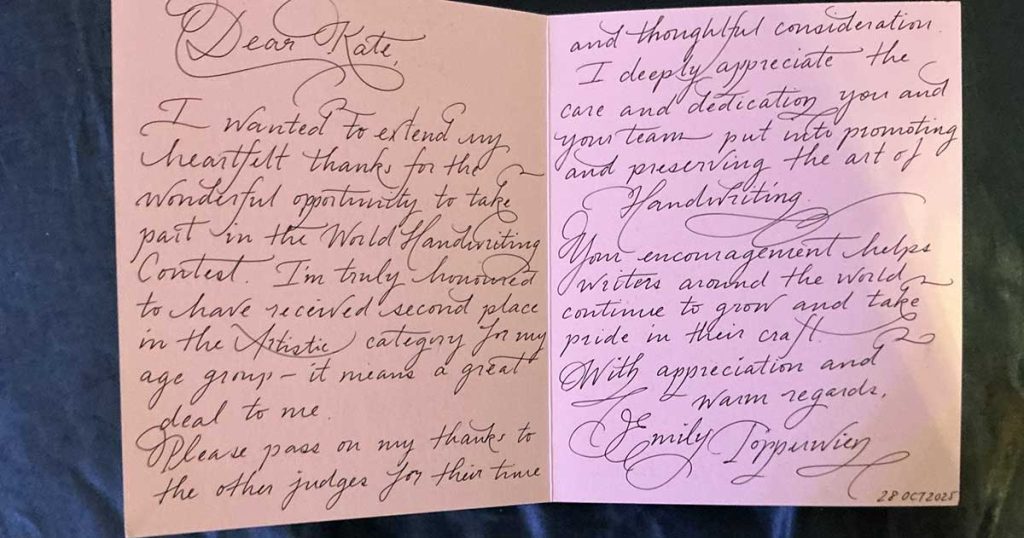
     World Handwriting Contest
    Lefties' Lounge for

    Southpaw Scribes

    Petition for

    Politician Legibility Act

    Home of the

    Handwriting Rebels


    Kate Gladstone -

    The Handwriting Repairwoman

    Kate Gladstone

    NEW ADDRESS

    325 South Manning Boulevard

    Albany, NY 12208 1942 USA

    telephone: 1 518 482 6763 

    e-mail: handwritingrepair@gmail.com


    Many physicians claim that pharmacists can always read any prescription, no matter how difficult, if they try. Yet numerous pharmacist- and physician-oriented journals, web-sites, and blogs display the most strikingly illegible "mystery scripts" chosen from among the thousands of prescriptions seen by the authors/editors or sent in by readers. Sometimes, after displaying one of these difficult puzzles the editor or site-owner provides the correct reading. However, patients deserve the correct medication more than "sometimes."

  • The prescription puzzle "guessing game" has serious consequences. Click here for the Institute of Safe Medication Practices' (ISMP) 16-July-1997 report of a case in which a physician, a pharmacist and a pharmacy all faced a lawsuit for damages as a result of a death caused by the physician's illegible handwriting - the report includes a graphic of the illegibly lethal prescription. According to the ISMP: "This [death] ... could set a new standard of practice."